Friday, 17 August 2018

Movie Review: Sonu Ke Titu Ki Sweety

"SKTKS" - Collision of Bromance and Romance

Luv Ranjan had returned with yet another film on urban relationships seen from a male perspective but it unknowingly also shows that men have some serious growing up to do!


FOSLA is a term I got to discover through social media. 'The Frustrated One Sided Lovers Association' seems to be peopled largely by frustrated men, at least in my limited experience. I’m told that there’s also a dedicated Facebook page for the community. Sonu Ke Titu Ki Sweety (SKTKS) seems like it's made for the young male members of this club, in fact all of Luv Ranjan’s films are. The way he has steadily stood by enthu-ridden young men, who have been disillusioned by women and failed relationships, FOSLA could well be called Ranjan’s genre. No wonder there are certain givens in his films—the young women are either full-blown bitches or weird wallflowers and then there is also another bunch—the loving elderly mainstreamers. No nuances are allowed even sideways. Not that one is complaining either; we can well imagine where all this deep-seated anxiety prompted by women is coming from.


Related image


Luv Ranjan is just Anti- Karan Johar type director who entertained audience with anti- romance flicks e.g. Pyaar Ka Punchnama and Pyaar Ka Punchnama 2.  

Titu’s (Sunny Singh) pending marriage with Sweety (Nusrat Bharucha) comes in the way of his friendship with Sonu (Kartik Aaryan). The traditional filmy triangle gets inverted. Instead of two men fighting over one woman we have the love for the woman coming in the way of male friendship. The representation of bromance is, in fact, more interesting in the older generation with what the grandfather (Alok Nath) almost joined at the hip with his bachelor buddy (Virendra Saxena). Is that Ranjan’s ideal? 


What about the women? Frankly, I was least offended. Empathise as young men may with the two heroes, Sonu and Titu also show how some men always prefer to remain boys. Unwittingly the two had me laugh at them than with them. The cute-hunk appeal aside which good woman would be able to spend more than two minutes with them? At 28 they seemed in urgent need of growing up and getting a life, reinstating my long held belief that modern Indian woman has indeed come a long way and men have some serious catching up to do. Men in the film complain about lack of “achchi ladki”; most women on the other side would have much the same to say about men. 


There are some genuinely funny, even if broad, punchlines and phrases, a sharpness and bite to the writing and good comic timing by the actors to make the first half a heady ride. The second half does get scattered, needless song-n-dance routines get rushed in as does a mandatory foreign location—Amsterdam. Things seem easily, melodramatically and illogically resolved but the cheekiness comes back in the climactic moments to restore the equality of every Bollywood movie.


Related image Image result for sonu ki titu ki sweety review


Luv Ranjan’s direction is splendid. He has made the film a racy entertainer which is what it should’ve been. Music (by Rochak Kohli, Yo Yo Honey Singh, Amaal Malik, Guru Randhawa, Zack Knight and Saurabh-Vaibhav) is very good. Most of the songs are fast numbers with appealing music. Even their most hit song 'Tera Yaar Hoon Main' the friendship anthem 2018 is very nice. Lyrics go well with the mood of the film. Song picturisations (by Bosco-Caesar) are eye-filling. Sudhir K. Chaudhary’s camerawork is of a fine standard. Akiv Ali’s editing is crisp and over all the movie has become 2018 one of the best drama movies with it's great story line and story.




Thursday, 16 August 2018

Restaurant Review: M & M.


Powai's Mirchi and Mime


The Good Lord be praised. This place pampers the palate with remarkable Indian cuisine which takes care of the wallet  with moderately prices and warms the heart with hearing-speech impaired staff. I just got an off today from my office and popped into Powai's Mirchi & Mime and left from there singing “SO AMAZING”!


Image result for mirchi and mime

Mirchi and Mime is a local restaurant located in Powai, Mumbai.. Its staff chiefly consists of people with hearing and speech disability. Most of the activities are undertaken by the staff who communicate with the customers through sign language, images of whose variations accompany every item in the food menu. 


Mirchi and Mime was founded by Henley School of Business graduates, Prashant Issar and Anuj Shah. Drawing inspiration from "Signs", a Toronto-based bistro which functions on a concept of hiring differently-abled people, Issar and Shah set up the restaurant in March 2015.

Mirchi and Mime only employs people who are hearing- and speech-impaired. Diners are requested to place their orders by mimicking hand-gestures associated with a particular food item. Items in the food menu are accompanied with photos of these hand gestures.The food menu matrix, which lists all food items in a single page along with the images, was designed by India's National Institute of Design. The staff were trained by Dr. Reddy's Foundation. 


The Decor:

Mainly the interior of the restaurant is very eye-catching. Kinds of spoons and vessels are hung up on walls or been framed. The ambience complimented the interior very well. A daylight themed ceilings and wall make can make any customer feel pleasant. Although on weekends the restaurant is full and pre-bookings are suggested. Other than that the Decor is a plus point for the place.


Image result for mirchi and mime interiors


Service:

Sure! The hearing and speech handicapped staff has not only been recruited through the help of special schools also been trained for 8 weeks but what shines through are the essential qualities of good service, eagerness to please, focus and their kind attention. It’s all explained at the start of the meal and you communicate with servers in sign language which makes you feel good in your own way.

Image result for mirchi and mime staff 


Now comes the best part of the blog...

Food: 

Mirchi & Mime bills itself as a fine-dining restaurant, but their friendly pricing belies this tag. Barring the New Zealand lamb chops priced at Rs925, and the jumbo prawns tagged at Rs875, nothing on the menu crosses Rs700, not even the lobster, of which there is a lot. What’s more remarkable, however, is that they have dared to include uncommon meats like guinea fowl and quail, and vegetables like raw jackfruit, parwal and shakarkand that are less utilised by restaurants. The food is progressive not by way of it's presentation that have become the hallmark of modern Indian restaurants, but more by way of unique flavour combinations.

The Must Try -  Duck Seekh (Rs315); Raw mango and prawn curry (Rs375); and Nutella and Toffee Tart (Rs185).


The 'Can Skip" - Assorted tawa platter (Rs185); and sitaphal panna cotta (Rs185).

 The Menu is filled with antique meals and flavours. The most ordered dishes from their menu is the kinds of seekhs they have - yellow mirchi tikka, stuffed kulcha, Nutella tart with vanilla ice cream, chicken tikka biryani, malai paneer seekh, all accompanied with beers or their mocktails.

Image result for mirchi and mime dishes Related image
Related image
Related image


This new Powai restaurant has its share of flaws, but it is nonetheless the most inspiring kind of restaurant story. It’s not a readymade brand imported from another city, no big-statement decor, but examines  great food at moderate prices (Rs 1,800 meal for two).
It’s not about gimmicks but good food. I love that. The speech-hearing impaired waiter’s shirt announces “Sign language is my superpower, what’s yours?” So, it’s not about do-good or pity it’s about empowering. I love that too!


Wednesday, 15 August 2018

Hard News


Demonetisation - The long and short impact


On November 8th, government announced the decision to discontinue the legal tender status of Rs. 500 and Rs. 1000 notes. The original objectives were stated as: eliminating fake currency; inflicting losses on those with black money; and disrupting terror and criminal activities. Later, new objectives were tacked on: enabling growth in bank credit, turning India into a cashless economy.

This time folks, at my fortnightly blog I am going to put a flash on some issues that common man went through during "NoteBandi".

                              Related image


When the act of demonetization flared up, the citizens of India adapted this change very swiftly. The cards were swiped more rather than exchange of notes. Observations in our day-to-day lives was spread out all over social media.


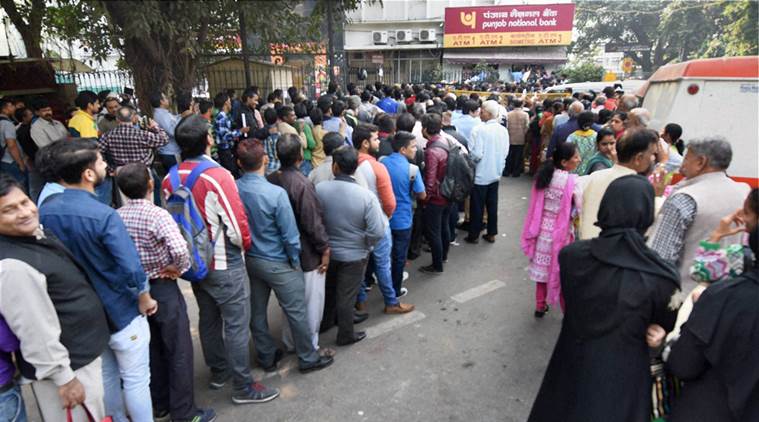
With almost no cash in hand available, the general public had to resort to ways and means to avoid using their left over legal tender and use them only sparingly. People started doing day today shopping of veggies/fruits in super markets instead of the neighbourhood vendor though he sold stuff fresh. People avoided auto rides by hailing on the roads and resorted to “Ola Autos/Ola Cabs” where they could pay by mobile wallets. Within few days as banks resembled Ration shops of the 80’s India with serpentine lines right from sunrise, vegetable and other vendors started accepting cheques for payment in fear of losing their customers. Most food establishments who had a minimum limit for accepting credit cards removed such limits. In the hinterland of India is where the impact was colossal. Though a big population was banked under Jan Dhan Yojana, till then they were not banking. The overnight shortage of currency, helplessness in otherwise carrying out day to today lives and finally the threat of losing business permanently pushed many to figure out alternate ways for making and accepting payments and they did. There was utter chaos for few days as the country came to terms with the move but ultimately in the long run, change did happen. In India normally change is slow. But under stress change is different!


Image result for demonetisation in hindi
As people across the entire nation queue up to exchange notes of Rs.500 and Rs.1000 there are still few people in the society who find this as a big task. Then, online payments comes to rescue. The impact on the life of a woman who handles her household chores deals with such chaotic economic structure of the country.


In a historic turn of events, Indian PM Mr. Narendra Modi in his speech, in an attempt to curb the curruption in the country, dramatically and yet thoughtfully, demonetized the 2 currency denomination. Logic? Well, the simplest rationale is to create accountability for the “recoverable” black money, fake currency and bring more transparency in to the cash transactions in the country.The announcement came heavy and totally taxing to a majority of unassuming viewers. I mean, you cannot make one oops two of the most valuable notes redundant just like that! Especially after Diwali and wedding festival when every one is smelling the valuable green currency for their upcoming shopping needs.


Related image Image result for poors during demonestisation


I fear that a broader understanding of the financial and economic lives of the poor yields an understanding of the impact of de-monetisation that is quite harsh.
Think of a middle class household with one salaried person earning Rs. 600,000 a year, with total financial investments worth Rs. 10,00,000. From the bank account, money is withdrawn and spent, or drawn down through card/online payments, or transferred into an investment instrument. If this person has a credit card, each purchase on the card would create two financial transactions of equal value - drawing credit, and repaying credit. Other than this, there may not be much "push and pull" in the person's financial life; only simple drawing down or investing up. She may occasionally take loans or switch across investment instruments. Financial turnover during a year is likely to be much lower than the total value of the financial assets owned. The cash portion of the transaction value may be smaller yet.


The sudden and swift move has caught all hoarders of black money unawares providing no major loophole to protect their holdings. Their opposition to the Government’s deft move is understandable. However PC is no ordinary person. He is a Harvard alumnus, top Supreme Court lawyer, former distinguished Finance Minister whose views and advice are sought by top business houses. He has an impressive following. His criticism of the Government’s demonetization move is surprising, in view of his intimate knowledge and hands on experience. He says he is perplexed. It is not clear why he has chosen to echo the seemingly inane arguments of his fellow politicians on this occasion. It is necessary to examine the arguments and assertions of this legal luminary.

With every change in the current scenario, we the citizens of India also need to do our bit. After all, this is done for the benefit of us citizens. Our duty is to fulfill all the requisites and be calm and patient.The key here is patience. When 86 per cent of a country’s legal tender becomes illegal, it is but expected that finding ‘a new level of equilibrium’ would require time. If the smaller short-term risks, especially those emanating from the demand side are addressed carefully, if we undertake a holistic net cost benefit analysis, the expected results seem to be promising.

For the evolution to be successful, we the people of India need to indulge in all required practices for a better tomorrow.


Ekādaśī


In today's blog I am going to acknowledge about Hindu's one of the most auspicious days. Many of ya'll must be aware of it but it's incredible how this festivity is traditionally mesmerizing so here I am sharing what I gained through the Hindu culture.

Related image

Ekadashi is a Sanskrit word, which literally means ‘The Eleventh’. It refers to the eleventh day of a fortnight of a Lunar month. There are two fortnights in a Lunar month—the bright and the dark. So, Ekadashi occurs twice in the month, in the bright, as well as the dark fortnight (twenty-four times in a year). These two days are considered especially auspicious for the practice of fasting or abstinence from food. Each Ekadashi has a unique name. It is an auspicious day dedicated to Lord Vishnu. 


Five things one must do on the occasion of Ekadashi :

Aside from being an Ekadashi, this day likewise praises the achievement of Vaikuntha, the profound kingdom of Lord Vishnu by Nammalwar. Here are 5 things prescribed for you to take after on this important day and look for the blessings of the Lord.

  • Chant the Hare Krishna MAHA MANTRAA

If it's not too much trouble to recite the Hare Krishna maha-mantra no less than 108 times (one round on the japa mala) on the arrival of Vaikuntha Ekadashi.
Hare Krishna maha mantra image
"Hare Krishna Hare Krishna Krishna Krishna Hare Hare
Hare Rama Hare Rama Rama Rama Hare Hare"

The least demanding way of acknowledgment in Kali-yuga is to recite the sacred names of Lord Krishna as prescribed in the Vedic sacred texts. The Hare Krishna maha-mantra is specified in the Kali-santarana Upanishad. 

Droning this mantra refines our heart, migrates us from the considerable number of tragedies throughout our life and eventually causes us accomplish profound flawlessness.


  • Serenade the Bhagavad-gita

Gita Jayanti typically falls on an antique day from Vaikuntha Ekadashi. However this time it was one month in front of Vaikuntha Ekadashi. 

Bhagavad gita Image

Gita Jayanti is the day when Lord Krishna trained Arjuna in the pith of otherworldly information. Henceforth, perusing the Bhagavad-gita is one of the very prescribed profound exercises on this day.

There are two sorts of writing celebrating the Supreme Lord Krishna. One contains the glories of the Lord and the other is specifically talked by the Lord. Since Bhagavad-gita was straightforwardly talked by Lord Krishna, there is no distinction between the Gita and Krishna. Perusing the Gita is in the same class as partner with Lord Krishna.

If it's not too much trouble invest some energy in discussing the verses of the Gita and understanding their importance.

  • Visit a temple of Lord Vishnu

If it's not too much trouble visit a sanctuary of Lord Vishnu or of any of His avatars in your neighborhood and take part in the Vaikuntha Ekadashi festival.

In a large portion of the Vishnu sanctuaries, an uncommon passageway called Vaikuntha Dwara is raised on this day. It is said that the individuals who go through this dwara on this promising day achieve Vaikuntha.

Vishnu temple

In the event that you have Deities of Lord Vishnu, Lord Krishna or some other of His avatars (Lord Rama, Lord Narasinha and so forth.) on the sacred place at your home, you can enliven the sacrificial table and Deities and play out an uncommon love alongside your relatives.

  •  Keeping a fast (Ekadashi Vrat)

Since this is an Ekadashi day, attempt to watch a quick. Fasting isn't just advantageous to our body and brain however it additionally has a great deal of profound advantages.

There are diverse levels of watching a quick and you may choose a level as indicated by your comfort. For more points of interest on the nourishments taboo on Ekadashi, diverse levels of watching Ekadashi, breaking the quick, and so on.

  • Offer  Seva to Lord Vishnu

You can offer the accompanying sevas at the sanctuary on this auspitious day and look for the endowments of Sri Srinivasa Govinda. 

  • Udayasthamana Seva
  • Vishesha Alankara Seva
  • Vishesha Naivedya Seva
  • Tulasi Hara Seva
  • Vaikuntha Dwara Archana Seva
  • Sripada Seva
  • Prasada Seva